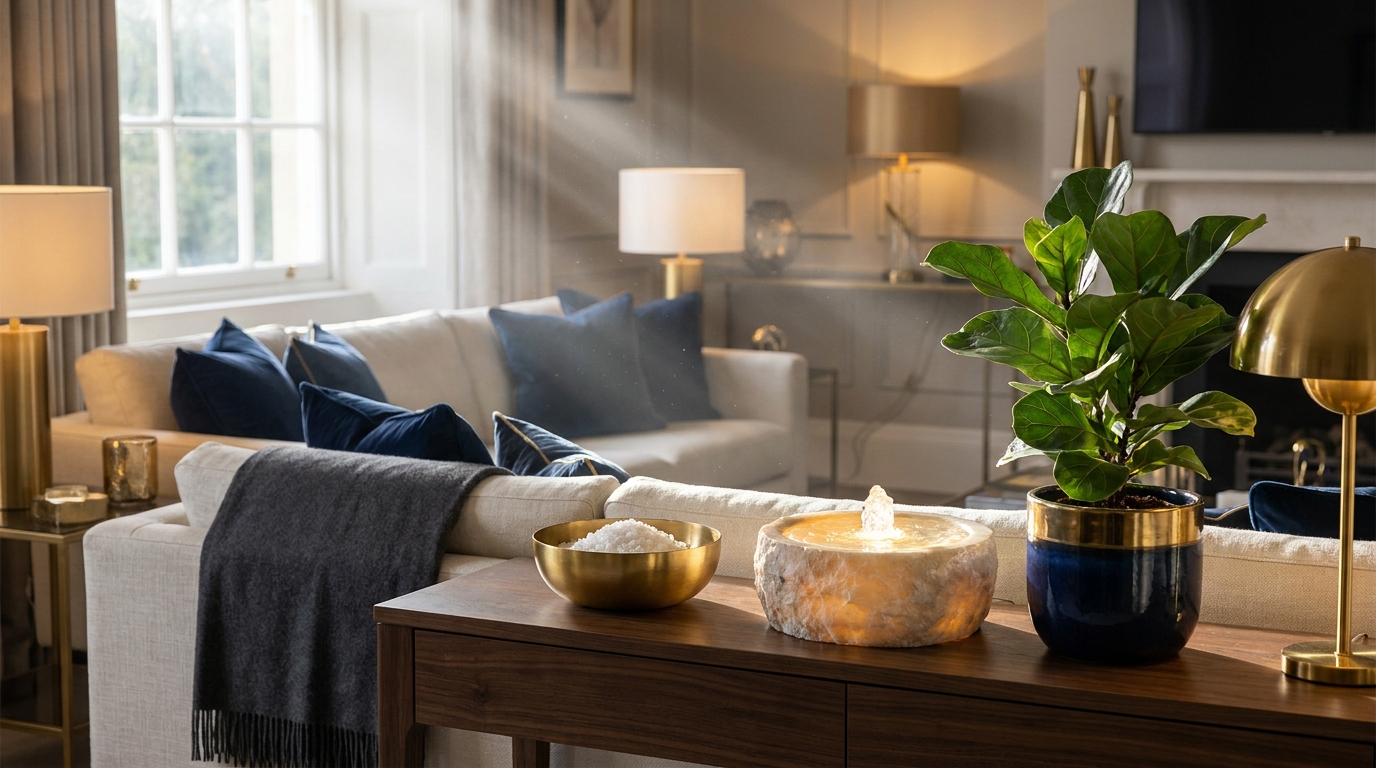
Most Vastu advice you find online assumes you own your home and can knock down a wall. Most people cannot. They rent, or they live in an apartment where the kitchen is where the builder put it and that is the end of the discussion.
The useful question is not “what would perfect Vastu look like?” but “what can I actually change?” This article covers five corrections that require no construction, no permission from a landlord, and in most cases no money.
First, the principle underneath it
Vastu Shastra organises space by direction. Each of the eight directions is associated with an element and a set of qualities, and the traditional guidance about where things belong follows from that.
North-east is associated with water and is treated as the most auspicious zone. South-east belongs to fire, which is why kitchens are traditionally placed there. South-west is earth, associated with weight and stability. North-west is air, associated with movement.
You do not need to memorise this. You only need a compass — your phone has one — and a willingness to notice which way your home actually faces. Almost nobody does this before rearranging furniture.
Five corrections you can make today
1. Move the heavy things to the south-west
The south-west is the zone of weight and stability. Traditional practice places the heaviest furniture there — wardrobes, storage, the master bed — and keeps the north-east comparatively light and open.
If your heaviest storage currently sits in the north-east corner, swapping it with something lighter is the single most commonly suggested correction, and it costs nothing but an afternoon.
2. Sleep with your head to the south or east
One of the oldest and most consistently repeated guidelines: head to the south, or failing that the east. Head to the north is the placement the tradition advises against.
In most bedrooms you can turn the bed without moving anything else. Whether or not you accept the reasoning, people frequently report sleeping differently after trying it — and it is a reversible experiment.
3. Clear the north-east corner
The north-east, or Ishanya, is treated as the most sensitive zone in the house. The tradition asks that it be kept clean, light and uncluttered — not used for storage, shoe racks, dustbins or heavy furniture.
If your north-east is currently where the junk accumulates, clearing it is a genuine Vastu correction, not a metaphorical one.
4. Fix what is broken or leaking
Vastu treats a dripping tap, a cracked mirror, a door that sticks, and a light that does not work as more than maintenance issues. Leaking water in particular is regarded as a drain on the household in a direct sense.
This is the least mystical advice on the list and possibly the most practical. Fix the tap.
5. Give the entrance room to breathe
The main door is where the tradition says energy enters the home. It asks that the entrance open fully without obstruction, be well lit, and not face a mirror directly.
Shoe racks immediately inside the door, a coat pile behind it, or a bulb that has been dead for months are all easily corrected.
What to do about the things you cannot change
Your kitchen is in the north-east. Your main door faces a direction the tradition considers difficult. You rent, and none of it is moving.
Traditional practice accepts this. There is a whole category of remedial measures — yantras placed in particular directions, specific colours, mirrors, plants, salt — intended for exactly this situation, where the layout is fixed and the occupant works within it.
Whether those measures do what the tradition claims is something each person judges for themselves. What is worth saying plainly is that Vastu does not require you to own or rebuild a house to engage with it.
A word of caution
Vastu attracts a certain kind of consultant who will tell you your home is the cause of every difficulty in your life and that only expensive structural work or costly items will fix it.
Treat that as the sales technique it usually is. Classical Vastu is a design tradition about light, air, orientation and use of space. It is not a system in which your staircase is responsible for your business troubles.
It is also, importantly, not structural engineering advice. If something in your home is genuinely unsafe, that is a job for a qualified engineer, not an astrologer.
Where to start
Open the compass on your phone, stand in the middle of your main room, and note which way is north. Then walk through the five points above and see how many already hold.
Most people find two or three easy corrections and one they cannot make. That is a normal result, and it is a far more useful starting point than a checklist written for a house you do not live in.
If you would like your own floor plan assessed properly, we offer Vastu consultations where a consultant reviews your plan and suggests corrections you can actually carry out. To study the subject in depth, our Vedic Vastu course covers the directional framework room by room.
This article describes traditional Vastu principles. It is not architectural or structural engineering advice.